The Following Excerpt(s) and Pictures are taken from Saint Demetrios’ A Celebration of the 50th Anniversary of Saint Demetrios Greek Orthodox Church, all credit is given to Fr. Nicholas Manousakis, Dianne Gilpatrick, Fred O’Neil, Angie Forest, Michael J. Forest, and the many wonderful parishioners who made our 50th Anniversary publication possible.
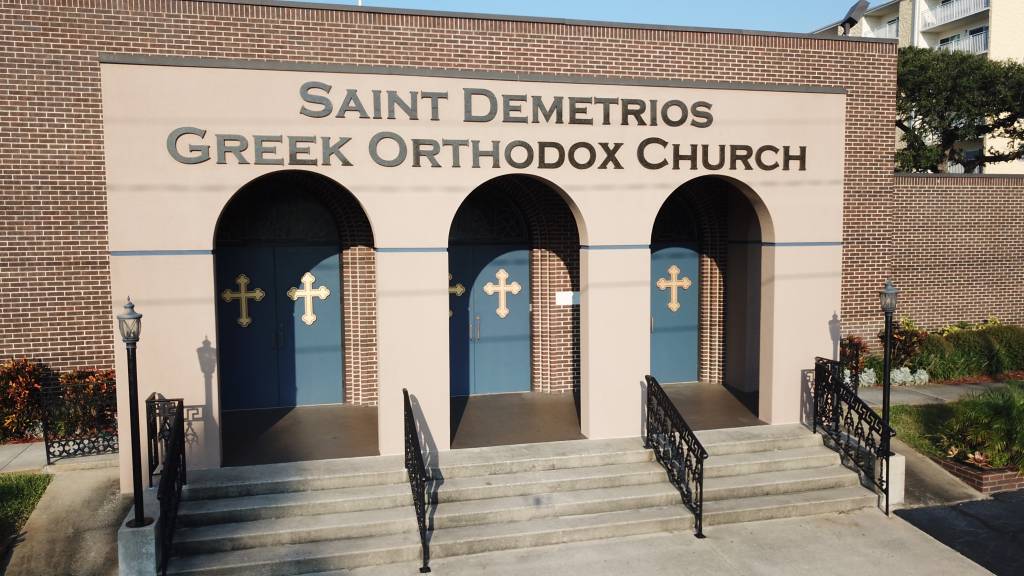
Saint Demetrios Greek Orthodox Church: From its Beginning to the Present
When the few Greek Orthodox in the Daytona Beach area wanted to attend church or celebrate a sacrament, they had to travel to St. John the Divine Church in neighboring Jacksonville or request a visit from its priest. In the 1930’s, 40’s and 50’s, this was a hard three hour, non air-conditioned automobile trip on a narrow, two-laned highway. Church attendance was generally limited to occasional services on Christmas and Easter Week.
During the late 1940’s, Father John Panos, who had family living in Daytona Beach, organized a handful of ladies to become the first Philoptochos Society. The dues were 50 cents per member. Fr. Panos impressed on the ladies the importance of women in the family and in religious life. He wisely referred to women as the heart of the family and the Philoptochos as “the mother” of the church. Conversation at the social gatherings would nearly always include thoughts and plans for a church.
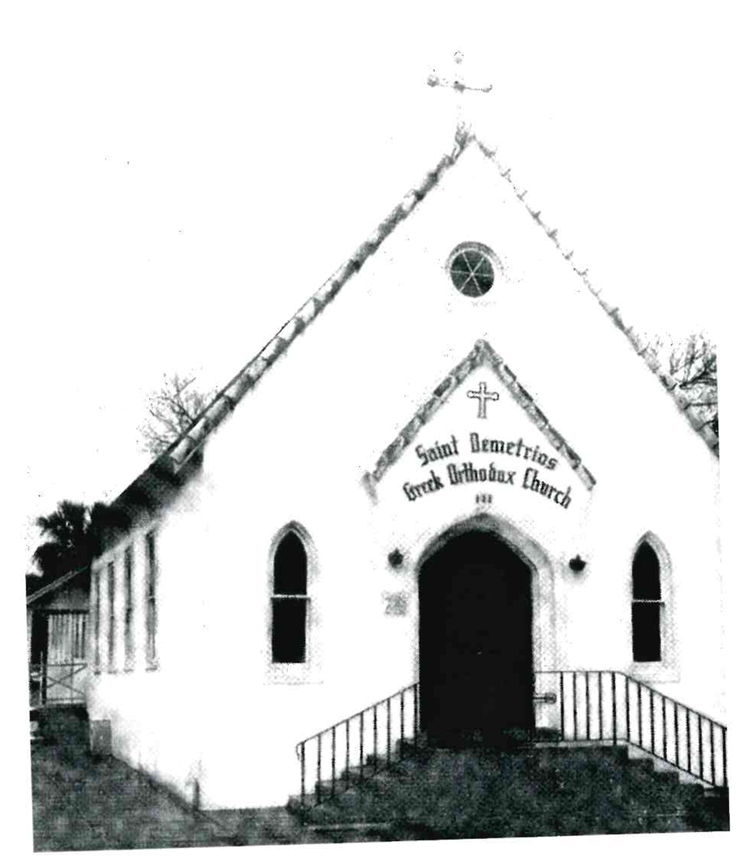
Through the years, a number of prospective properties were selected and later eliminated until 1952 when three members of an elected board took it upon themselves to purchase a Seventh Day Adventist Church with funds collected for that purpose by the thirty-odd families that formed the Greek Community. Many members disliked the autocratic way that the decision was made but immediately stepped up to the challenge of restoring the Protestant church to a tiny jewel of a Greek Orthodox Church. The existing structure was enlarged by extending the building to the rear with a hall which served as the priest’s office, Sunday School classes, meeting room and fund-raising social gatherings.
The lot was 50′ wide and 100′ deep with enough room at the side of the church for the priest to park his automobile and for church goers to walk to the hall at the rear of the church. The community hungered for its own place of worship and for the opportunity for their children to learn about their religion. They longed to have the young people learn and maintain their common traditions, customs and values.
The first church service was celebrated on Saint Demetrios Day, Sunday, October 26, 1952. In the congregation were a number of individuals named Demetrios and it was decided, on the spot, that the church would be named in honor of the patron saint. To seal their commitment each Demetrios pledged $100.
Rev. Father Archimandrite Nyphon Demetriou was the first priest to serve the community, serving from 1952-1954. Father John Panos, who had moved to the area, served until 1956 when Father John P. Athas arrived. Under the leadership of young Father Athas, the community activities grew through the establishment of a Sunday School, P.T.A., choir, a group of altar boys, GOYA, Greek School and Summer Bible School. The women of Philoptochos were the right arm of the church. The church was without paid employees so the cleaning of the church, hall and grounds were taken care of by the young priest, his Presvytera, Sophia, their three children, the ladies of Philoptochos along with a few devoted men and children.
There were frequent community fund-raising dinners, dances, craft sales, rummage sales and raffles. Baked goods were prepared and sold on street comers by ladies of the church without complaints of weather conditions. Rummage sales were held in vacant store buildings near areas where it was felt the less fortunate would be seeking bargains. Nominal rent was paid for the space but electricity and water were never provided.
A building committee was formed to begin searching for a new church site and to look for means to fund the structure. Many locations were discussed including existing Protestant churches until a vacant piece of property was finally selected on South Peninsula Drive in 1957.
By 1961, nine years after the tiny new church was opened, the mortgages were paid on the old Cypress Street church and on the new Peninsula Drive site. There were no large donations from any one individual. All monies were collected through dues and trays, through the efforts of the many church projects and the frugal ways that the community members did what was needed. Altar boy robes were sewn, walls were painted, cupboards were built. When there was a need, a member would do the work or have the work done at his own expense. The proverbial hat was passed or an amount was assessed of the Parish Council members before other parishioners were approached and asked to contribute. Nearly every Saint Demetrios Day Dinner Dance and Greek Independence Day Dance was sponsored by contributions that were raised from Parish Council members and a few business men.
Most church members owned small family businesses. They lived totally within their means and were readily willing to make contributions to their church as needed. It was very common to have members contribute funds towards a church dinner or party, buy the materials for the function , spend their days preparing and cooking, selling tickets and decorating. They would then buy tickets for their family, serve the guests the meals and finally remove their aprons and enjoy the festivities. Before leaving for the evening, they stayed to clean the facility.
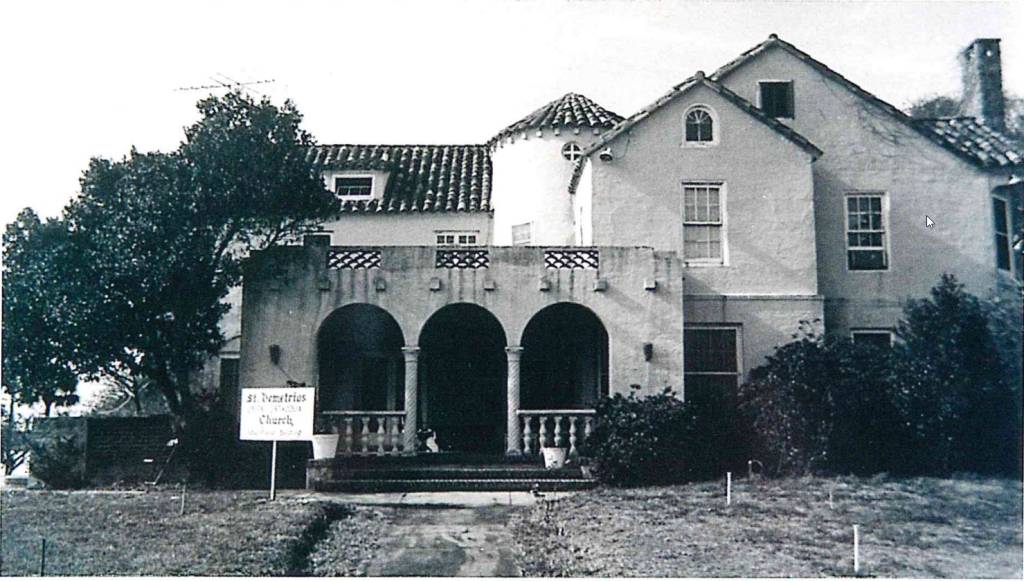
As the time neared to build the new church at the Peninsula Drive location, the homeowners in the area rejected the idea of having the traffic of a church in their neighborhood. Rather than becoming embroiled in controversy, the Community decided to search for a new location for Saint Demetrios. God definitely had a hand in the delay because the far more desirable property on North Halifax Avenue, the home of deposed Cuban dictator, Fulgencio Batista, became available.
The South Peninsula Drive property was sold September 13, 1964 and a month later the Cypress Street church was sold. The old Batista house was converted into a tiny church with an office, classrooms and meeting hall. The community was growing rapidly when a group of young, devote General Electric Company engineers and their families moved to Daytona Beach.
In 1969, Father Athas and his young family moved to Clearwater as the priest of its new community. He was replaced by Father James Karalexis who was with us long enough to break ground on our new community center that served as a church, meeting room and rental facility until our church structure was built. The facility served as a much-needed source of funds as it was the largest banquet room in the city.
By 1973, under Father Nicholas Geotes, plans were being made to fulfill the membership’s dreams for a new Saint Demetrios. Construction began in 1974. February, 1975, under Father George Papadeas, the dreams of hundreds of individuals were fulfilled when the doors of the church opened. The church was fully and completely adorned within two years of its opening through the grace of God and the solitary focus of a small community of God-loving people.
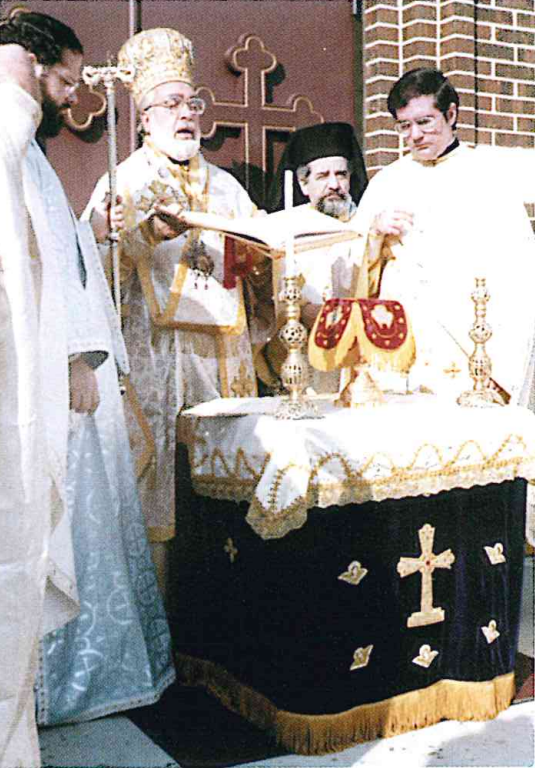
On October 16, 1977 His Eminence Archbishop Iakovos consecrated the new church, sharing his admiration for this small but faithful congregation. He openly declared that proportionately and comparatively, our church ranked as the number one parish in the Archdiocese.
Soon after Father Papadeas arrived in Daytona Beach, he guided the community through the establishment of a most successful and well organized indoor/outdoor Greek festival with the first troop of young Greek dancers, an Olympic-type torch run from City Hall, our very professional church tours, attractive and very tasty foods and pastry.
With Father George’s retirement, Father Nicholas Manousakis arrived in 1983. As an innovator, he initiated the summer alumni altar boy Sundays, the Father’s Day father-son altar boy Sunday and a junior choir. He began an in-church recognition of couples celebrating 50 years of marriage. A special plaque and roses are presented to acknowledge the special accomplishment of these loving individuals.
The Forty Day Blessing of infants was conducted on Sundays after the Liturgy and in the presence of the entire congregation. He established the YAL and re-established the Seniors ‘ VIP Club. Father Nick has been especially vigilant in recognizing long-term church volunteers by honoring them at special functions and awarding them with a plaque. There has been a Founder’s Day Dinner, a Man of the Year award, the sole Archdiocesan Laity Award, Choir Appreciation Luncheons and many other recognitions for highly worthy individuals.
The community prides itself in being acknowledged for having the most organized and financially successful Clergy-Laity Conferences in the Diocese in 1993 when 175 members attended. We also hosted two Diocesan Choir Conferences, an Archdiocesan and a Diocesan Oratorical Conference.
The Saint Barbara’s Philoptochos Society initially worked to meet the church’s needs and to administer to the needs of a very few local emergencies. It has grown and expanded to become a strong member of the National Philoptochos Society. It now assists charities both locally and on a national level.
As the millennium began, Saint Demetrios found itself in a time of transition. The area was been left behind economically as other central Florida areas surged ahead with the arrival of many theme parks and large corporate offices. The local tourist industry, that propelled the family-owned businesses in the past, was in a state of change and demographics of the church have changed. The community was aging and there are fewer children. The young adults are far less involved than were their parents. The early parishioners met their physical needs and hungered to meet their need for church and their ethnicity.
There were and still are mixed marriages in the church with faithful converts and there are also church marriages with little or no participation in the life of the church after the ceremony. There are active Russians, Serbs, Lebanese, Syrian and other ethnic Orthodox members of the church with the young speaking little or no Greek. The Sunday service is in both Greek and English.
From 2003-2008 the parish came underneath the care of Fr. George Savas. During his tenure, Fr. George did many things to reinvigorate the youth ministry at the parish, eventually leading him to become one of the youth directors at our Metropolis’ Diakonia Retreat Center.
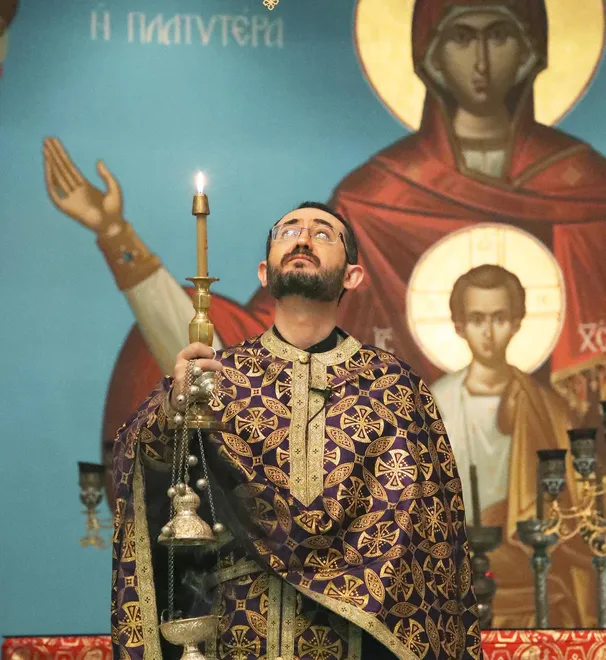
Following Fr. George, from 2008-2024 the church came under the care of Fr. Joseph Samaan. Fr. Joseph was a trilingual Syrian priest originally from the Antiochian Archdiocese, who came under the omophorion of Metropolitan Alexios. Fr. Joseph was a highly educated priest with degrees from the University of Athens in Greece, St. Vladimir’s Seminary in Yonkers, NY, and St. John of Damascus Theological School in Balamand, Lebanon. Being the second longest presiding priest the parish has had, Fr. Joseph poured himself into the community leading the parish through many stages of its development and growth.
Fr. Joseph was a very liturgically active priest and during his tenure at Saint Demetrios he served nearly daily services, including visiting and co-celebrating with many of our other Orthodox brothers and sisters across the state. A particular focus of his stay was on families and young children, and at the end of his period of service here, he helped cultivate a healthy class of cradle, convert, and catechumens, bringing new life and faith into our church.
2024-Now
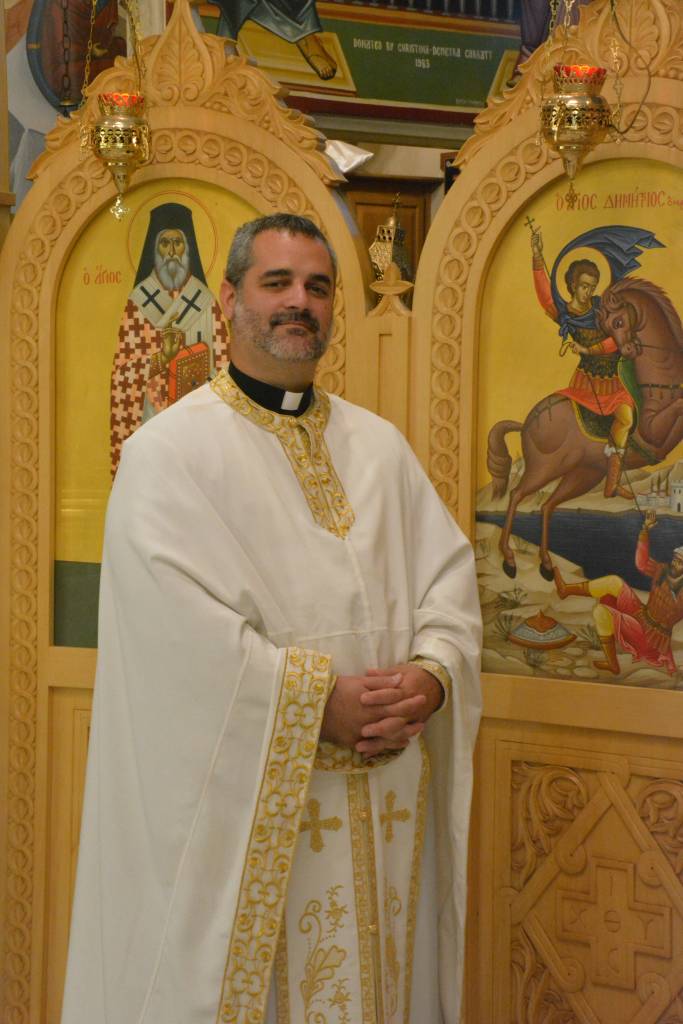
Currently our parish is under the sprititual care of Father Alexander Kamilaris. He received a Masters of Divinity from Holy Cross Greek Orthodox School of Theology, and was ordained to the Holy Diaconate in May of 2019, and to the Holy Priesthood in August of the same year. From 2019 to 2024 he served as the associate priest at Saint Mark Greek Orthodox Church in Boca Raton, and in June of 2024 he and his family were assigned to our community.
Already during his tenure here, Fr. Alexander has helped to expand our ministries and especially the reception of new members into the Orthodox Faith. We look forward to living and growing in the faith with him for many years to come.